Start with the promise your channel already makes
Most idea lists fail for a boring reason: they were written for nobody in particular. Thirty formats only help if you already know which of them your viewers expect from you.
Write one sentence that answers three things at once: who the channel is for, what they get in each video, and how often you publish. "Practical home cooking for people who work late, one recipe every Tuesday" is a working promise. "Food content" is not, because it decides nothing.
Keep that sentence where you plan. Every idea you write down has to survive it. When an idea does not fit the promise, you have two honest options: rewrite the idea until it does, or change the promise and accept that the channel is moving. What does not work is publishing the idea and hoping the channel catches up.
The promise also gives you a test for viewer expectation. A subscriber who came for a 90-second story will not stay for a 20-minute explainer. If an idea only works in a format your viewers have never seen from you, treat it as a new channel, not as this Tuesday's upload.
You do not need software for this step. One page, one sentence, and a willingness to delete the ideas that flatter the channel rather than describe it.
Run every idea through three fit filters
Channel fit, viewer expectation and publishing rhythm answer different questions, and an idea has to pass all three. Use the same three questions for every candidate so that you compare ideas with each other instead of reacting to whichever one feels exciting that afternoon.
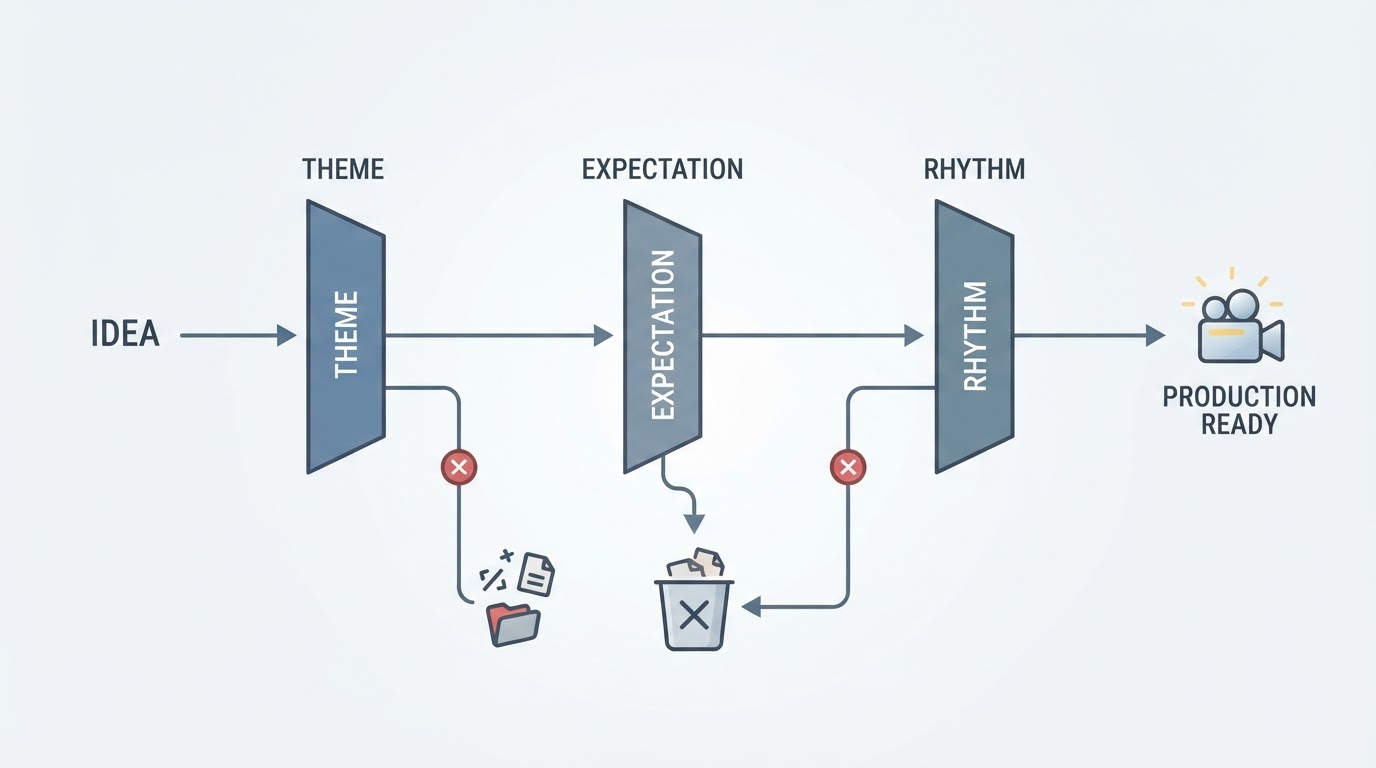
Filter | Question to ask | Idea that passes | Idea that fails |
|---|---|---|---|
Channel theme | Is this the same subject my channel already covers? | A tool review inside a channel about woodworking | A travel diary inside a channel about woodworking |
Viewer expectation | Is this the format and length my viewers keep coming back for? | A six-minute build with a clear result | A thirty-minute vlog in a channel of six-minute builds |
Publishing rhythm | Can I make this in the time I actually have, every week? | A recurring format with a fixed shooting setup | An idea that needs a new location, cast and edit style each time |
If an idea fails one filter and you still want it, change the idea rather than the whole channel. The travel diary can become a "where I source wood" segment inside the build. That keeps the promise and still gives you the material you wanted to shoot.
Write the filters down before you brainstorm. Deciding afterwards turns them into a justification for whatever you already wanted to make, which is how channels drift without anyone noticing.
Test whether one idea can carry a series
A single good video pays for one shoot. A series pays for the setup, the format you learned, and the audience that now recognises the channel. That is why series potential is worth judging before production, not after the fourth upload.
Check for a spine. A series needs one question or one running situation that stays true across episodes, while each episode still delivers something complete. "One small apartment, one new constraint each week" has a spine. "Things I like" does not.
Then check variation. Write the first six episode titles in one sitting. If the titles are interchangeable, you have one episode and five repeats. If each title creates a different specific promise, you have a series.
Finally, check direction. Episodes can vary in subject but should stay inside a single visual and tonal direction, because viewers recognise a channel by how it looks as much as by what it covers. Fix the art direction and let the subject move.
One rule worth borrowing from serialised production: avoid making episodes depend on each other. If the fifth episode only makes sense after the fourth, new viewers have nowhere to start, and you can never publish out of order when production slips.
Check production cost before you get attached
Production cost is not only money. It is the number of decisions each episode forces you to make again. A format that needs a new location, a new guest and a new edit style every week will quietly cost you the series.
Run this checklist on the two or three ideas you like most:
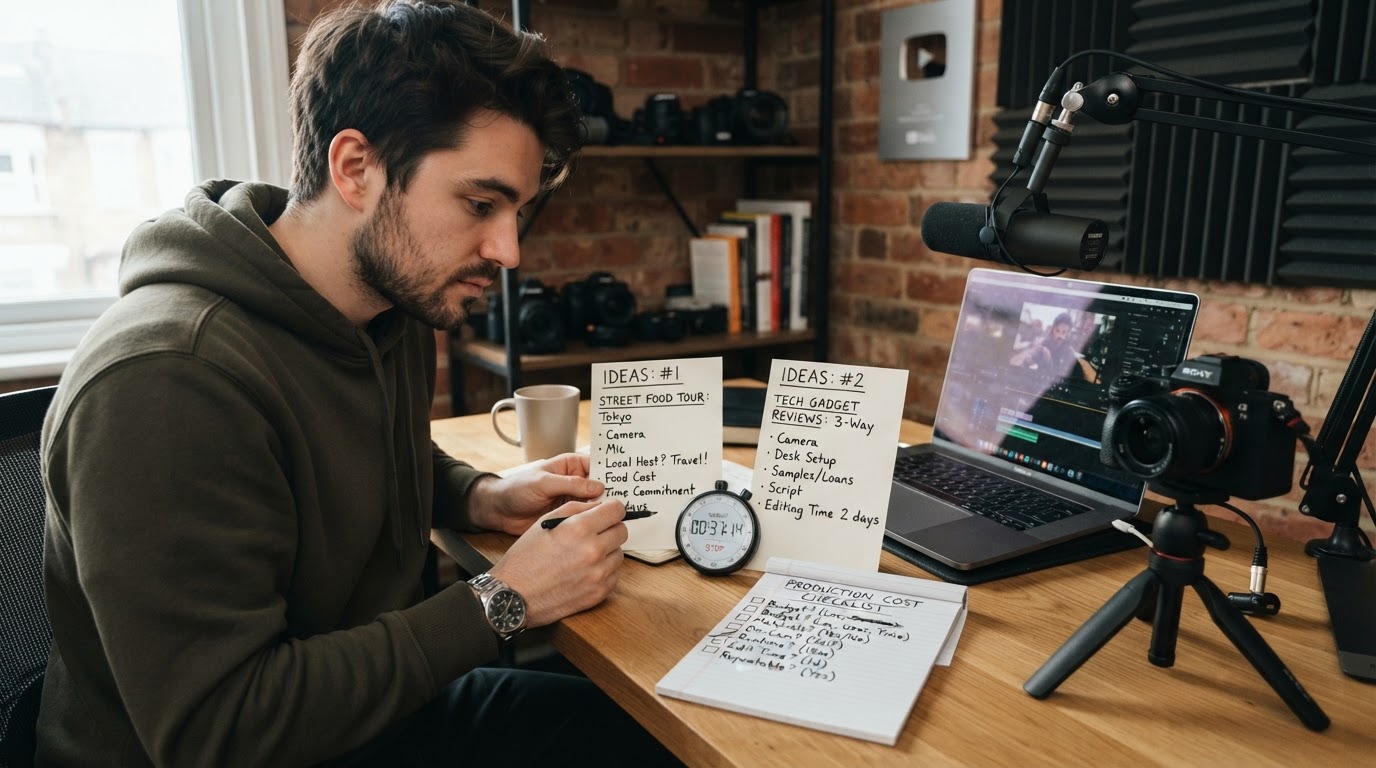
- Materials: what has to exist before you can start? Footage, props, samples, a finished product, a person willing to appear.
- On-camera presence: does the idea need your face, a performer or a voice? If yes, does that hold for episode ten as well as episode one?
- Runtime and edit shape: what length does the idea actually need, and can you cut it in one working session?
- Review cost: how many rounds of changes will each episode need, and who decides that it is finished?
- Repeatability: can you shoot two episodes in one session, or does every episode need its own day?
Be honest about review. It is the step creators under-budget most often, because it leaves no trace in the finished video. If every episode needs three rounds of revision, the series will run on your evenings.
What a rejected idea still gives you
Rejection is data, not waste. An idea that fails the rhythm filter often contains a segment that passes it. An idea that fails the theme filter is often the seed of a second channel you should not start yet.
Keep the reason next to the idea. "Too expensive this quarter" and "wrong audience" lead to different decisions later, and a short note saves you from re-arguing the same concept every few weeks.
Find candidates without a trend report
You do not need a dashboard to collect candidates; you need material you can actually make. Four sources stay reliable: questions people already send you, the parts of your last videos that drew the most replies, work you already do that has a visible process, and formats you can repeat with the same setup.
Write each candidate as a sentence with a subject and a promise. "Three ways to fix a stripped screw with one tool" beats "tool tips", because the second one cannot be filmed or judged. If you cannot finish the sentence, what you have is a mood rather than an episode.
Date every entry. A candidate that has waited two months without getting easier to make is answering a question about your capacity, not your creativity.
Where planning material helps, and where it doesn't
Frameworks get you to a decision. Documents keep that decision available three weeks later, when you are tired and the next upload is due.
Meltica publishes planning material aimed at exactly this stage: story outline and beat planning examples with timecoded beats, storyboards that note what each shot reveals, and series examples that hold a few episodes in one visual direction. The examples are read-only, and each episode still needs its own review, since characters and voices are not guaranteed to match across episodes. That distinction is the useful part: a planning guide can keep a series consistent in intent, not identical in output.
What such material does not give you is trend evidence. It will not tell you which subject is rising on YouTube this month, and it should not be treated as if it did. Check anything time-sensitive against current sources before you build a month of episodes on it.
Keep a shortlist that survives your calendar
A list of ideas is not a plan; a shortlist with dates is. Keep one running page with four columns: the idea, the filter it nearly failed, what it costs to make, and the earliest date it could publish.
Review it once a week for fifteen minutes. Promote one idea, retire one, and write down why the retired one failed. That note is what keeps the shortlist short enough to be useful.
Then do three things this week. Write the promise sentence. Put your five strongest candidates through the three filters and the production checklist. Write six episode titles for the one that survives. If you cannot write six, you found a video rather than a series, and knowing that early is cheaper than discovering it in week four.