Aim, Hook, Payoff: Settle Three Decisions First
A script fails quietly when the writer opens a blank page and starts typing lines. The lines are the last decision, not the first. Before any dialogue exists, three answers do most of the work: who is watching, what single thing they should take away, and why they would still be watching at second twenty.
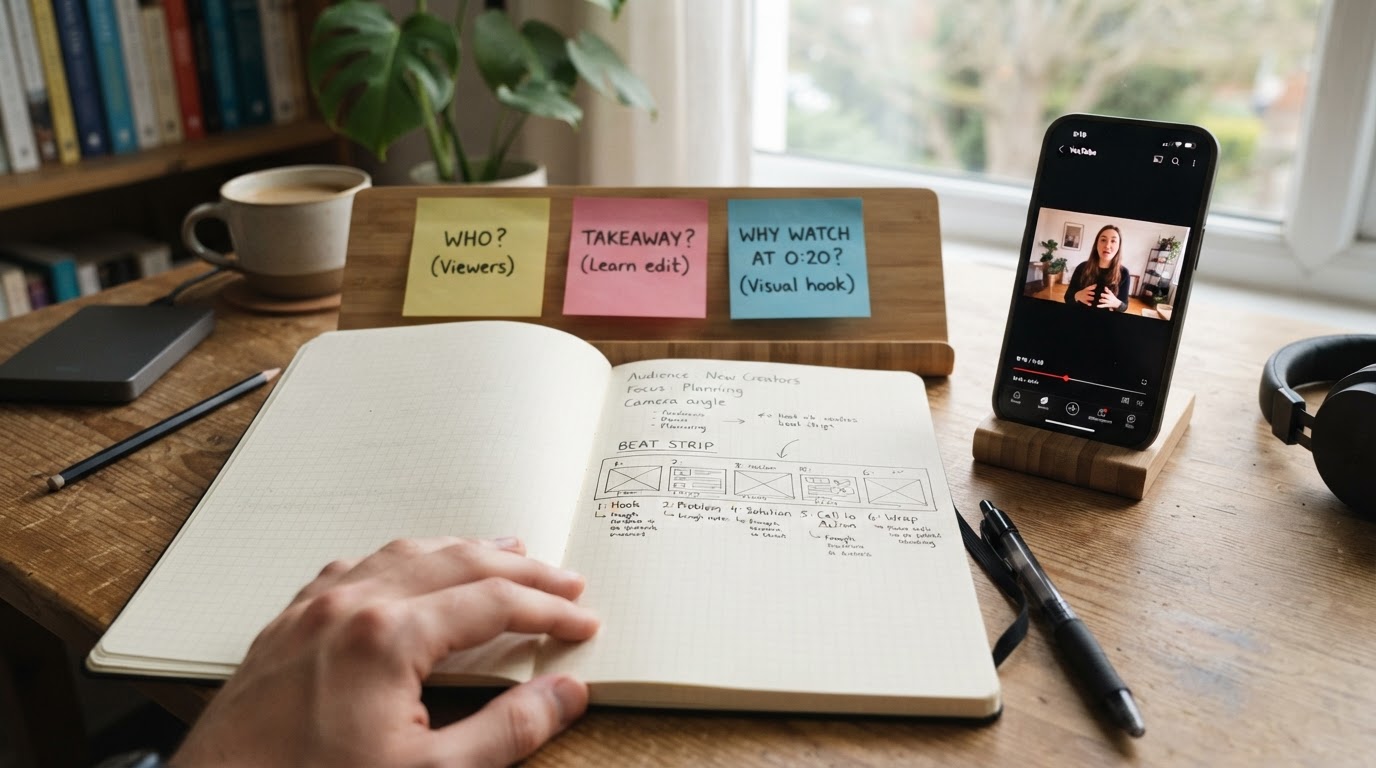
The aim. Write it as one sentence with a verb the viewer performs: "book a trial lesson", "stop storing references in screenshots", "understand why the last video died at second three". If two aims compete, split them into two videos. A short film with two aims reads as one aim and one leftover.
The hook. A hook is a promise with a cost attached. A vague question costs nothing to watch, so viewers leave. A specific claim plus something the viewer can check — a before-and-after frame, a number you can defend, a mistake you can name — buys the next three seconds. Write the hook last, after you know what the payoff actually is.
The payoff. Say what the viewer gets for staying, plus one reason they might rewatch: a repeated frame that reads differently the second time, a checklist worth screenshotting, a next step they can act on tonight. If you cannot name the payoff in one sentence, the video has an ending rather than a payoff.
Keep these three answers at the top of the brief. They are the acceptance criteria you will test the cut against later, when you no longer trust your memory of what you meant.
Beat, Shot, Reason: Build the Timed Strip
Timecodes turn an intention into something you can shoot, generate, or argue with. A 30-second short needs roughly six beats; a 60-second one, nine to twelve. Each row carries four things: when it happens, what happens, what the viewer sees, and why the beat is allowed to stay.
Timecode | Beat (what happens) | Shot (what the viewer sees) | Why it stays |
|---|---|---|---|
0.0–2.5s | Claim or question that names the viewer's problem | Close frame of the failure itself, already in motion | Buys the next three seconds |
2.5–6.0s | Context: who this is for and what changes | Wide frame of the workspace, one object in reach | Keeps the wrong viewer out |
6.0–12.0s | First move, described in plain steps | Over-the-shoulder frame of the first action | Turns interest into a procedure |
12.0–20.0s | The turn: what most people get wrong | Side-by-side frame of wrong and right | Creates a reason to keep watching |
20.0–27.0s | Payoff: the finished result in view | Final state, held long enough to read | Delivers the hook's promise |
27.0–30.0s | Close: one action, one sentence | Return to the opening frame, now changed | Makes a rewatch meaningful |
Write shots, not moods. "Feels energetic" cannot be filmed, generated, or checked. "Hands cut the card at frame edge, camera locked, no zoom" can. A row that contains only an emotion is not a beat yet.
Give every row a reason. The reason column is where dead beats die. Usual entries: it prevents a misread, it proves a claim, it releases tension built two rows earlier, it sets up the payoff. "It looks nice" is a reason to delete.
Watch for the common failure. The most expensive mistake in a short video script is a beat sheet that jumps from hook to result with no turn. Viewers do not stay for information; they stay for a change. If nothing in the strip reverses — a mistake corrected, an assumption broken, a cost revealed — the middle has nothing to carry.
Timecodes are estimates, not promises. One page of a two-column script runs roughly one minute of finished video, so read the draft aloud with a stopwatch and rewrite the rows that overrun. Keeping the strip in seconds lets you see the pacing before you spend a generation credit or a shoot day.
Line, Label, Level: Keep the Three Tracks Apart
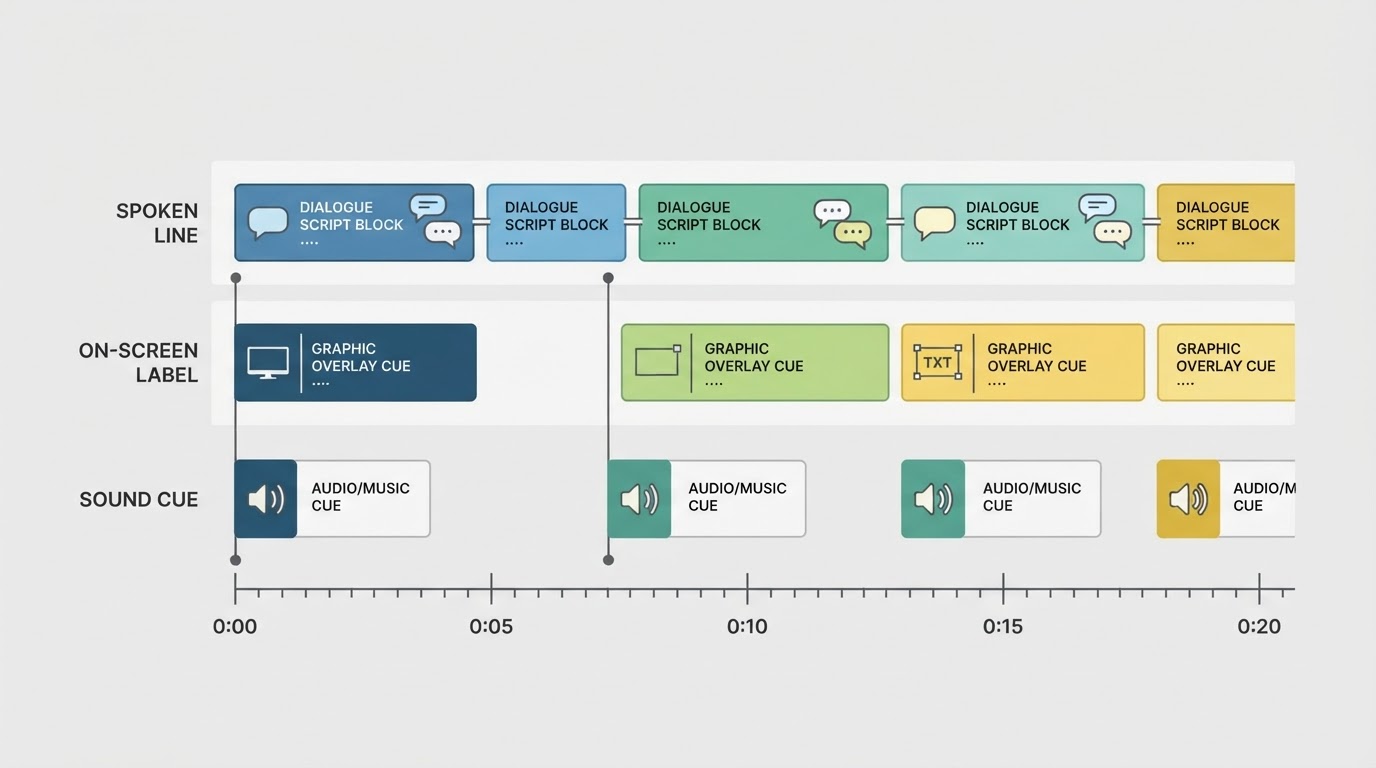
Collapse everything into one paragraph and problems hide until the edit. Splitting the page into three tracks — spoken lines, on-screen text, sound — makes each element reviewable on its own.
Line. What the voice says, written to be heard: short clauses, contractions, no stacked subordinate clauses. Read each line aloud; if you run out of breath, the viewer loses the sentence.
Label. What appears as text: the on-screen title, the two- or three-word label for each step, the closing call to action. On-screen text is not a transcript of the voice track. If it repeats the line word for word, delete the text or delete the line.
Level. What the viewer hears underneath: music entry and exit, room tone, a hard stop before the turn, silence held for a beat before the payoff. Sound decisions are the cheapest to write and the most often skipped, which is why so many short videos feel flat even when the words are fine.
A three-track entry for a single beat looks like this:
- Line: "You do not need a better camera. You need a better second three."
- Label: "SECOND THREE" appears bottom-left at 0:03, held 1.5 seconds.
- Level: music cuts at 0:02.8, one beat of room tone under the line, music returns on the cut at 0:06.
Review the tracks in order: line alone, label alone, level alone. Each pass catches something the combined read hides, and every note becomes specific enough to hand to a shooter, an editor, or a generation request without another meeting.
Borrow the Three Principles, Not the Footage
Studying a reference video is the fastest way to learn structure — as long as you take the structure and leave the material behind. Work in three steps.
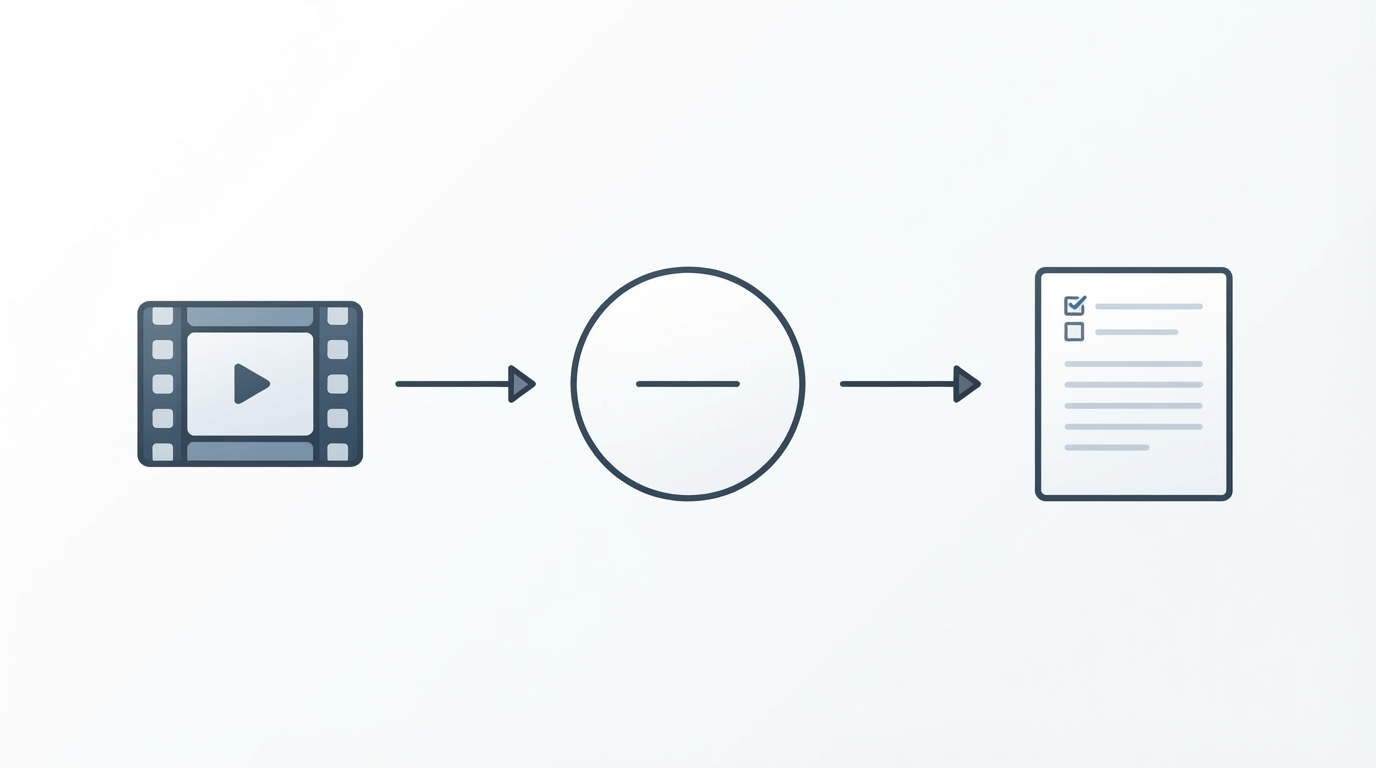
1. Mark the reference. Watch it twice: once for the story, once with a timer running. Note the second the hook lands, the second it turns, the second it pays off, and how long each shot is held. You are building a timing map, not a shot list.
2. Name the principle. Behind almost every reference sits one transferable decision: a promise made in the first frame and kept in the last, an escalation that adds cost each time, a repeated image that changes meaning. Write the principle as one line that contains no reference-specific noun.
3. Rebuild with your own material. Same principle, different subject, different visuals, different lines. Keep the shape of the escalation; replace the framing, the objects, the words, and the faces.
This is also the cheap legal answer. Finding a reference grants no rights to its footage, music, or the likeness of anyone in it, and borrowing those is a claim on someone else's work. Borrowing a pace and a structure is craft. Keep the timing map, discard the frames.
A worked example makes the transfer concrete. A reference opens on a cluttered desk, cuts to a clean one eight seconds later, and holds the clean frame for five seconds while a line lands. The principle: visible cost, then visible relief, then a hold long enough for the relief to register. Applied to your own subject, the desk becomes a folder full of unused references, then a single list of three beats; the five-second hold stays, because that hold is what makes the relief legible. The frames, the words and the person in them are all yours.
The Handoff Brief: Goal, Materials, Request, Review Points
A script you cannot hand off is a script only you can finish. The brief that travels with it should fit in four short blocks.
Goal. One sentence with the aim, the audience, the platform and the target length. Example: a 30-second vertical short for solo creators who save references and never use them, aimed at getting the viewer to write one beat sheet tonight.
Materials. Everything a shooter, editor or generation request needs: the timed beat strip, the three-track script, the reference principles you are allowed to borrow, brand assets, fonts, aspect ratio, and any footage already cleared. List what you do not have as clearly as what you do.
Request. The exact output you expect back: a first cut that respects the beat strip to within a second, or a generated video built from the specified shot list. Name the deliverables, their order, and the deadline. Ambiguity here is what turns a brief into three rounds of revision.
Review points. The two or three decisions you will actually check, tied to the hook, the turn and the payoff. Say what would send the work back: a hook that resolves nothing, a dropped sound cue, an on-screen label that repeats the line.
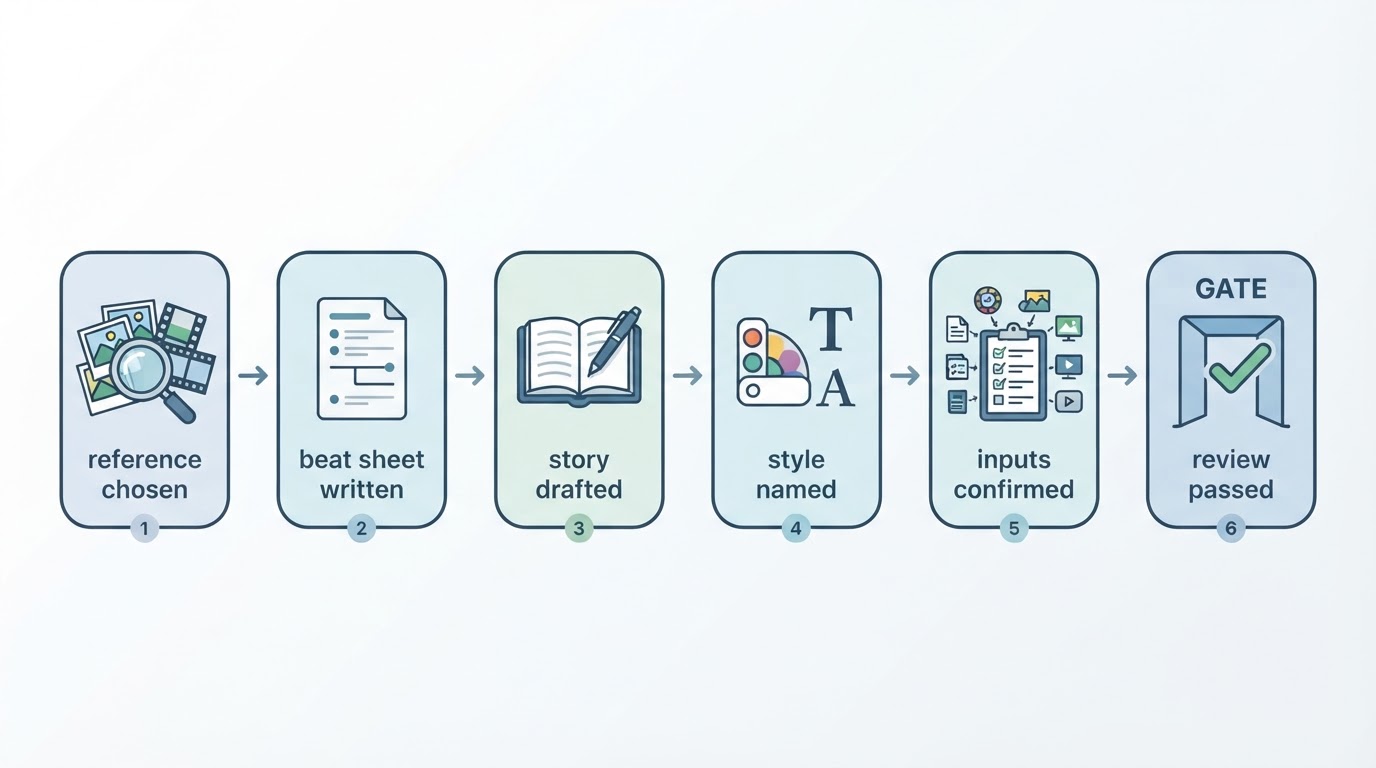
Before sending it, run this checklist:
- The hook can be checked against something on screen, not only against a claim.
- Every beat in the strip has a shot and a reason to exist.
- Line, label and level sit on separate rows.
- The turn reverses something; the middle is not just more information.
- Reference principles are named without their original nouns.
- Any borrowed footage, music or likeness has a cleared right to be used.
- The payoff arrives after the cost, with a held frame long enough to read.
- One close, one action, one sentence.
Three Things to Carry Into the Next Video
Start with one aim, and let the hook promise exactly what the payoff delivers. Time the middle as a strip of beats with shots and reasons, so dead rows become visible before you spend a shoot day or a generation credit. Keep dialogue, on-screen text and sound on three separate tracks so each can be fixed on its own — and when you learn from a reference, take the pace and the principle, then rebuild the rest with your own material.