Why A Saved List Of Ideas Rarely Fills A Week
Most people collect short video ideas the same way: they save clips that performed well, keep a list of concepts in their notes, and then freeze when it is time to film. The list is long but unusable, because every entry is a copy of someone else's finished video rather than a decision about what your own next video should do.
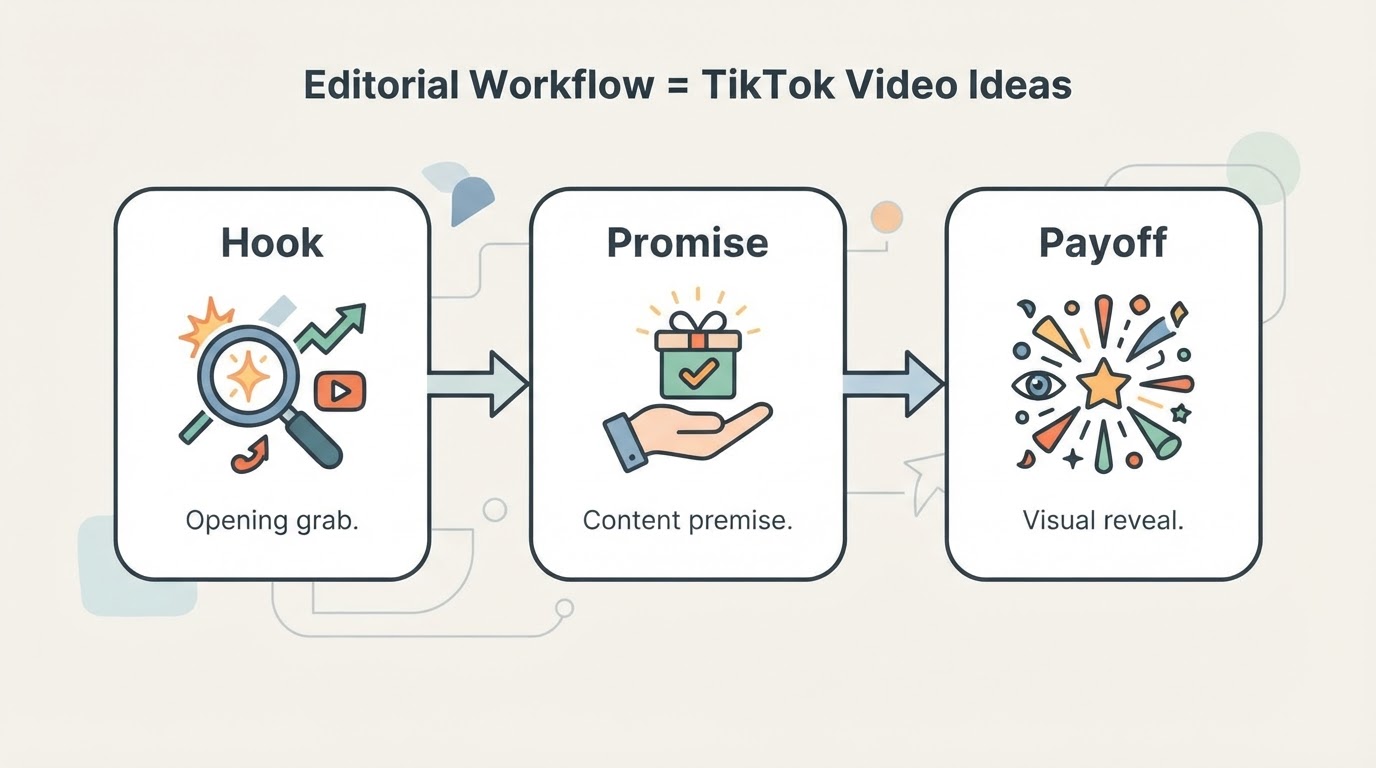
The fix is to change the unit you collect. Instead of saving ideas, save hooks — the first thing a viewer sees and hears — plus a note about why the hook held attention. An idea becomes usable when you can say three things about it: who it is for, what it promises in the opening line, and what you will show once the viewer stays.
That shift also makes the work faster. A finished video takes hours, so it feels expensive to reject one. A hook takes one line to write, so you can reject ten of them without losing a day.
The Three-Part Test Every Candidate Idea Has To Pass
Before an idea earns a place in your shortlist, run it through three questions in order.
Does it belong to this account? Your account teaches the viewer what to expect from you. An idea that would work on a general entertainment channel but not on yours is not a bad idea; it is a bad fit. Write the idea down, put it in a "not for this account" column, and move on.
Can you state the promise in one line? If the best description you can produce is "something about my process", the idea is not ready. The opening line should make a specific claim the viewer can judge: a mistake you avoided, a result you reached, a comparison you ran, a question you answered. Vague ideas survive on execution, and execution is the part you cannot guarantee.
Can you show something? Short video rewards visible change: before and after, a messy desk becoming a clean one, a claim being tested on screen. If the idea only works as talking, it still can work, but you need a visual proof point planned in advance or the middle of the video will sag.
Ideas that fail one question can often be repaired by narrowing them. "My editing workflow" fails the second question; "the one step in my editing workflow I stopped doing" passes it. Narrowing is how a weak idea becomes filmable.
Build A Shortlist From Formats, Not Trends
Trends change weekly and rarely match what your account is for. Formats are more durable, because they describe the shape of a video rather than its subject. A handful of shapes covers most short-form work, and each one carries its own promise to the viewer.
Format | What the opening line promises | What the viewer stays for |
|---|---|---|
Behind the scenes | A look at how something is actually made | Details you would not see in the finished result |
Listicle | Several quick answers to one problem | The next item, because each one closes fast |
Expectation vs reality | A gap between the advertised and the actual | The reveal, and the explanation of why the gap exists |
Reply to a comment | An answer to a real question | Whether the answer matches what they suspected |
Before and after | A visible change | The middle steps that caused the change |
Story with a lesson | A moment that changed something | The lesson, and whether it applies to them |
Breakdown on screen | A close reading of an example | The reasoning, because the example is right there |
Favourite tools or picks | A short, honest set of options | The criteria, and where each option fails |
Pick two or three formats that suit your account rather than all eight. Then generate ideas inside those formats: for each one, write the opening line in the viewer's own words, and write what you would show in the second and third beat. A single format can produce a month of candidates this way, because the subject changes while the promise stays consistent.
Separate What You Can Borrow From What You Cannot Reuse
This is the step most people skip, and it is the one that keeps you out of trouble. When you study a reference video, sort what you noticed into two piles.
The first pile is structural: the order of beats, the length of the opening, where the payoff lands, how quickly cuts arrive, whether text carries the argument or the voice does. Structure is a set of decisions, and decisions can be learned from and rebuilt with your own material.
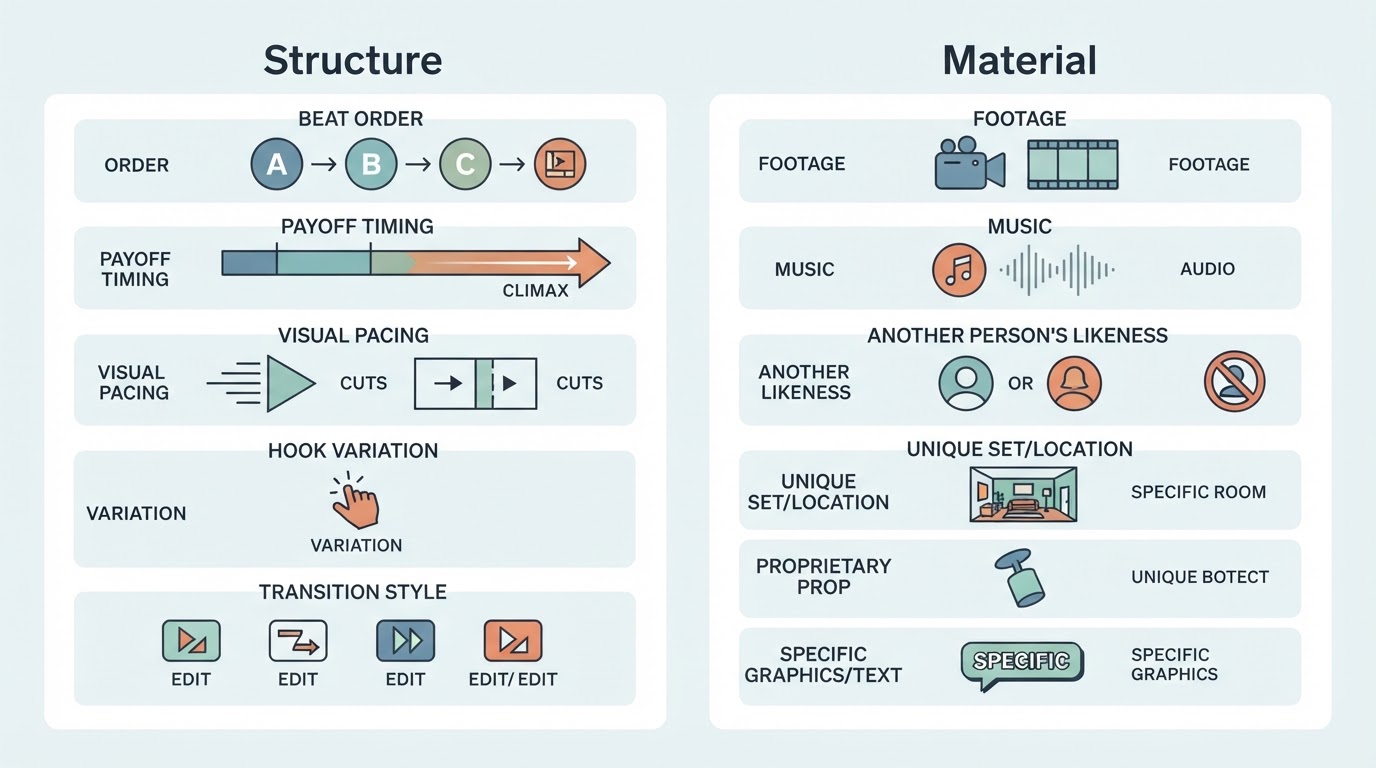
The second pile is material: the footage, the music, the voice, the on-screen person, someone else's artwork or product shots, and jokes that only work in their wording. Finding a video does not grant permission to reuse any of it. A saved reference is a lesson, not a licence.
Two practical tests help when you are unsure. Would the video still make sense if you deleted everything visual and read only your own words? If yes, the idea lives in your script. Would the video still be recognizable as someone else's if you swapped your own footage in? If yes, you are copying the material, not learning the structure.
Compare Candidate Hooks By Hand, Before You Build Anything
You do not need a tool to compare hooks. You need a repeatable routine that stops you from judging on vibes.
Start a note with one column per question: what the hook claims, who it claims it for, what it shows in the first beat, how quickly the payoff arrives, and whether your account can honestly deliver it. Then fill one row per candidate. Reading rows side by side usually exposes two or three hooks that are really the same idea wearing different wording.
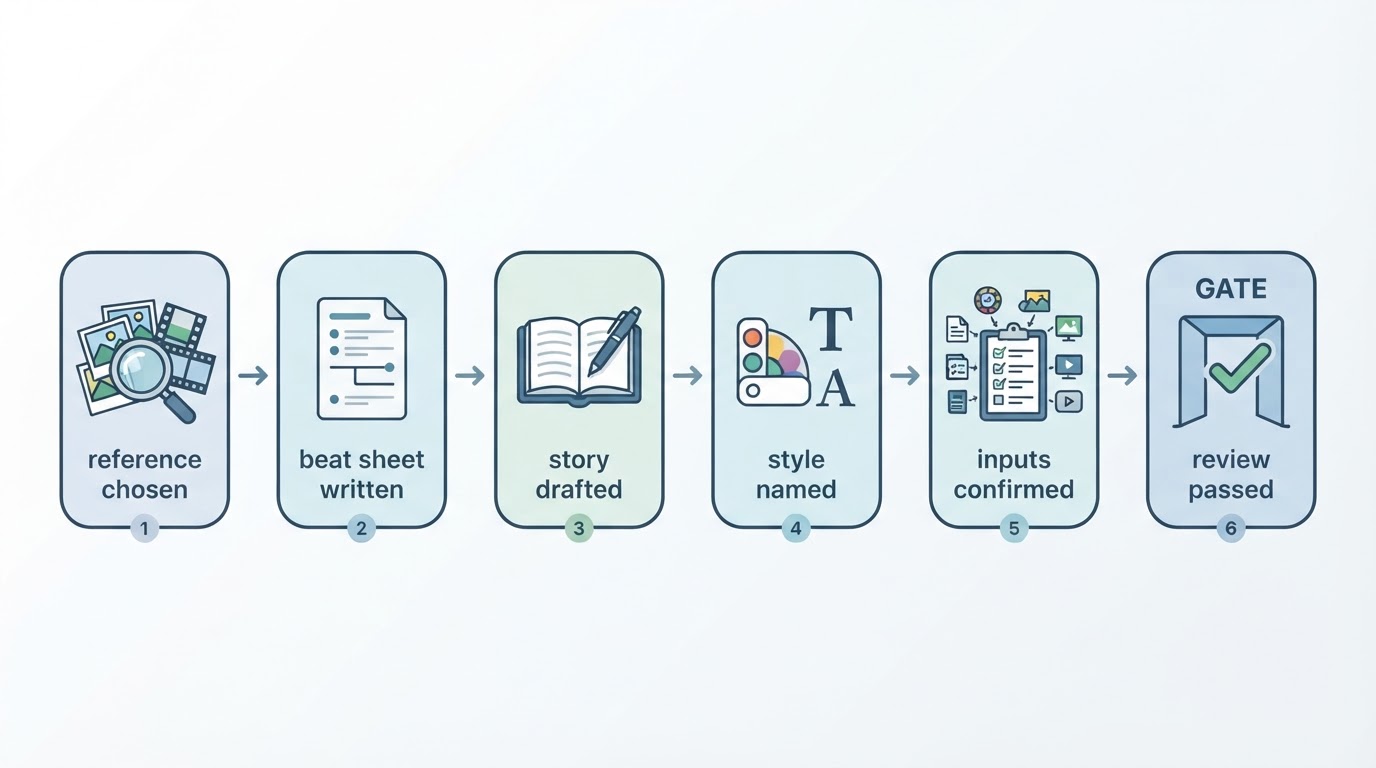
Next, collect a small set of references and pause each one at its opening. Write a plain description of what happens in the first beat: what is said, what is shown, what is withheld. Compare those descriptions with your candidates. You are looking for a shape you can fill with your own subject, not a script to follow.
One caution about this stage: a collection of references is a snapshot of what you noticed on the day you looked, not a live ranking of what currently performs. Ages, view counts and engagement on saved clips tell you what was visible when the clip was collected. They are not evidence about your account, your audience, or next week's performance.
Test The Idea In One Take Before You Commit
A hook that reads well on paper can still collapse when spoken. Film one rough take of the opening line and the first three seconds of what follows. No lighting, no edits, no music.

Watch it back with two questions. Would someone who does not know your account understand the promise without reading captions? And does the first beat actually show what your hook claimed? Most ideas die here for a fixable reason: the hook promises a demonstration while the first beat delivers an introduction.
If the take feels slow, shorten the setup rather than speeding up the delivery. If the take feels confusing, name the subject earlier. If the take feels dishonest, the idea needs a narrower claim, not louder wording.
Where A Guided Workspace Fits Into This Step
Everything above works with a notebook, a phone and a saved collection of clips. A guided workspace helps mainly when the deciding step is the slow one, and Meltica approaches it by publishing its method rather than hiding it behind a generator. Its public guides cover planning a short video series, analysing TikTok video references step by step, and choosing a TikTok video idea, and the reference-analysis guide includes a worked brief example you can read before you write your own. Rights guidance is built into the same material: finding a reference grants no reuse rights to footage, music or likeness, and reading a guide never transfers a brief, uploads material or submits a task.
Use it as a companion to the routine above. Take your shortlist, read how the reference-to-brief step is broken down, and write your own brief from your own material. If your bottleneck is only the first line of a video, the guide is optional; if your bottleneck is turning a reference into a brief you can actually shoot or generate, the guide covers that conversion directly.
The Trade-Offs Worth Knowing Before You Rely On References
Reference-led work has limits worth stating plainly.
The first is age. A reference shows what was visible when it was collected, and pacing habits move faster than a saved list does. Recheck the date on a reference before you build a whole video around its rhythm.
The second is fit. A structure that works for a loud, fast account can sound strained on a quiet, careful one. Borrow the order of beats, not the energy.
The third is honesty. The safest hook is the one your own footage can satisfy. When you cannot show the promised result, promise the process instead: what you tried, what changed, what you would do differently. Viewer trust survives a modest claim; it does not survive a broken one.
The fourth is time. Sorting hooks, comparing references and testing one take costs an afternoon and saves the week you would have spent building the wrong video. That trade is the whole point.
A Short Checklist For This Week
- Pick two or three formats that fit your account.
- Write ten hooks inside those formats, one line each.
- State who each hook is for and what you will show in the second beat.
- Keep only hooks your own footage can honestly satisfy.
- Compare the survivors side by side, and merge duplicates.
- Study three references, writing down structure separately from material.
- Film one rough opening take, then keep, narrow, or drop the idea.